SinexcelPCS / inverter – central / containerised
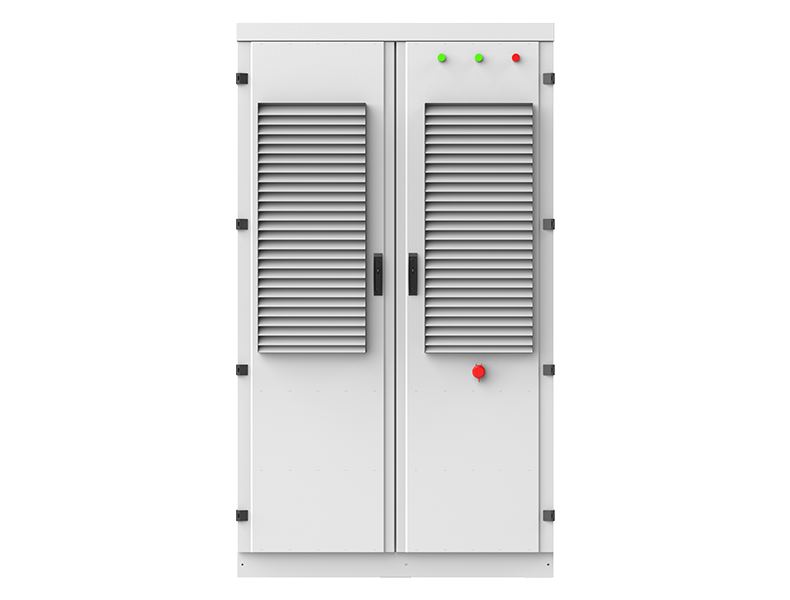
Sinexcel 750 kW HVDC Cabinet (PDS1-750K-H)
Modular 1500 V DC/DC converter cabinet (1–8 × 100 kW) with MPPT for DC-coupling high-voltage PV and battery systems.
DC-coupling made modular: the PDS1-750K-H connects high-voltage PV strings directly to the battery bus with multiple MPPT inputs and bidirectional 100 kW modules, up to 750 kW per cabinet at 98.96 % peak efficiency. The efficient way to add storage to an existing PV plant without touching the AC side.
Key specifications
| Nominal power | 750 kW, scalable 100–750 kW (1–8 × 100 kW modules) |
|---|---|
| DC range | 500–1500 V, nominal 1000 V, 750 A nominal |
| Peak efficiency | 98.96% |
| Function | bidirectional, multiple MPPT inputs, ms-level response |
| Enclosure | IP54, forced air, <85 dB |
| Dimensions/weight | 1200×2100×970 mm, 292 kg + 51 kg per module |
| Operating temp | -20…50 °C |
| Certifications | UL1741, IEC EN 62109-1, IEC EN 61000 |
Manufacturer data; details, options and current revision in the official datasheet. Subject to change.
Typical applications
- DC-coupled PV + storage retrofits
- Peak shaving
- Renewable integration
- Frequency regulation in C&I and utility plants
Why from BST.SOLAR?
- Design and sizing for your load profile – not a catalogue sale.
- Installation, grid connection and ComAp-based control from one team.
- Commissioning, remote monitoring and O&M support in Hungary.
Application in practice
The PDS1-750K-H is a modular 1500 V bidirectional DC/DC converter cabinet, not an AC inverter: it DC-couples a high-voltage PV array directly to a battery, with multiple MPPT inputs tracking the PV strings. In Hungary we apply it where a PV plant has a constrained grid-connection capacity, so midday surplus is stored instead of clipped, or where a hybrid plant must deliver a firm evening profile for HUPX trading or aFRR. It sits between PV, battery and the central PCS, with the EMS coordinating charge and discharge.
BST designs the DC bus architecture, the split of PV strings across the MPPT inputs and the protection concept, and integrates the converter with the BMS, PCS and our EMS. One to eight 100 kW modules let us match the converter to the actual PV-to-battery power flow and expand later. The IP54 cabinet can be installed in a container or sheltered outdoor location within -20 to 50 °C; we size the ventilation accordingly. Commissioning covers MPPT behaviour, current limiting at 750 A and millisecond-level response to EMS setpoints.
When to choose this product
- You want to DC-couple PV and battery at 1500 V rather than converting PV to AC and back, reducing conversion losses.
- Several high-voltage PV string groups must each be tracked separately, so multiple MPPT inputs are required.
- Your DC bus operates at 500–1500 V and the required DC transfer power is up to 750 kW, scalable in 100 kW modules.
- A grid-constrained plant needs to store clipped PV energy or firm its output for trading or ancillary services.
Frequently asked questions
Do I still need a PCS when using the PDS1-750K-H?
Yes. The PDS1-750K-H is a DC/DC converter that moves energy between the PV array and the battery on the DC side; it does not produce AC. A PCS, such as a Sinexcel string or central unit, is still required for the grid or load connection. BST designs the complete DC-coupled architecture including both.
How is the PDS1-750K-H sized for a DC-coupled PV plant?
The converter is sized to the DC power you expect to route between PV and battery, not to the full PV capacity, typically the portion exceeding the grid connection limit. With one to eight 100 kW modules and 750 A nominal current, BST selects the module count from the PV profile, battery C-rate and grid limit.
What efficiency can be expected with DC coupling via the PDS1-750K-H?
The converter has a peak efficiency of 98.96 percent, and because PV energy is stored without an intermediate DC-AC-DC conversion, overall round-trip losses on the charging path are lower than in an AC-coupled layout. The actual plant figure depends on operating points, which BST evaluates in the design phase.
Need this equipment for your project?
Send us your load profile or project outline and we return a sized proposal with delivery time.
Call our engineering team: +36 1 451 8070